Virtually every project management web application on the market today creates silos of users. What happens is that a company generally will create an account on Basecamp or one of the other tools, and add all of the users to that account. Overall, this is fine. But it’s not perfect because usually people have side projects and moonlight on the side.
From day one we’ve had a better model, which is to let each person stand as their own silo, and link their accounts as needed. This means that you can choose who you share projects with, and other people can invite you to link accounts.
Here’s a graph that shows how Basecamp currently operates:
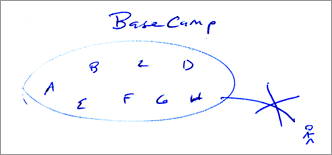
Diagram A: As you can see, users are created in a virtual container. If you log into a Basecamp account you can see all of the projects for that company, but you can’t easily have your own projects, hidden from your co workers. And you can’t link Basecamp accounts together.
I know a lot of people who have Basecamp accounts, and give user logins to their freelancers. Some freelancers end up with a whole bunch of different login passwords. This creates confusion.
So that’s why we had a better idea. A way to break the silo. Here it is:
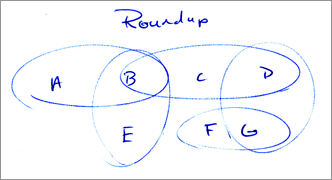
Diagram B: We like the concept of “linking accounts” — when you link accounts with someone, they can share or you can share projects. People just see the projects they are added to. In addition, you can designate someone as a “co-owner” of a project enabling them to add other people to that project.
The beauty behind this approach is that your data becomes something you own (even if it is for other peoples projects), and allows you to track all of your time, tasks, and projects in one place.
Please note that this post isn’t meant to be a rant against Basecamp. It’s truly a great product. I simply thought it was useful for explaining how things can be better. Some people don’t need what we offer, and that’s fine.